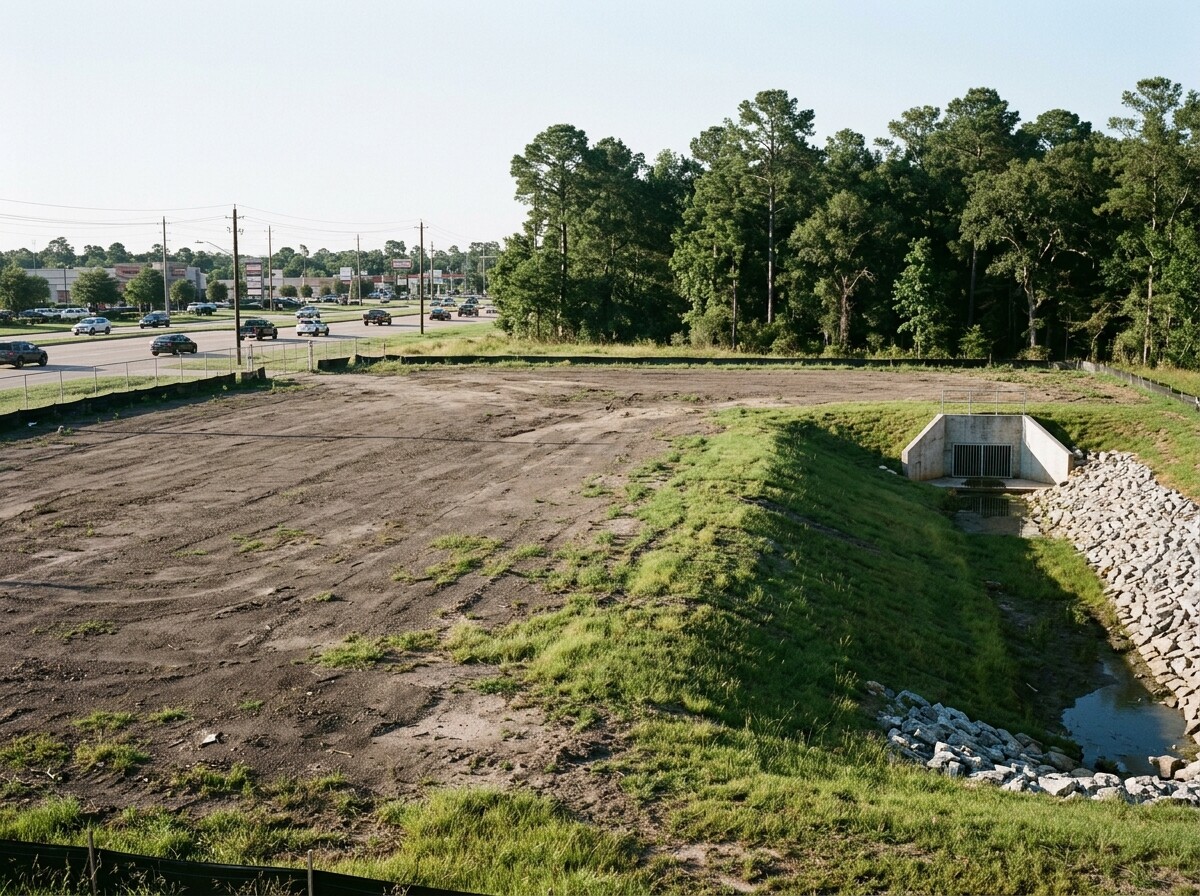
Buying a commercial hotel pad site in the West Houston Energy Corridor comes down to two things that don't show up in a drive-by site visit: off-site stormwater detention capacity and recorded title easements. On prime West Houston freeway frontage, land prices are too high to waste half your tract digging an on-site dirt detention pond, which means your entire project depends on whether the shared master detention basin actually has the legal and hydraulic capacity to take your storm runoff.
We executed the pre-acquisition civil drainage and title due diligence on this West Houston hotel parcel. We audited the shared off-site stormwater detention agreements and encroachment permissions, reviewed the title commitment and pipeline/utility easements line by line, verified domestic water and sanitary sewer tap availability, and checked the highway curb-cut geometry.
Technical Specifications & Commercial Land Acquisition Scope
Auditing commercial hotel parcels along congested Texas highway corridors involves analyzing subsurface easements and regional drainage infrastructure:
- Stormwater Mitigation & Off-Site Detention Easement Analysis: We audited off-site detention basin agreements and drainage easements shared with adjacent commercial office properties. We verified that existing excavated pond storage volume fulfilled Harris County Flood Control District criteria for the planned hotel building footprint and paved parking areas. We analyzed historical engineering drainage calculations to confirm the retention pond could handle peak discharge without overtopping adjacent commercial parcels or violating local watershed outfall limits.
- Permission to Encroach & Drainage Easement Agreements: We reviewed legal covenants governing shared detention facilities, evaluating draft agreements for permission to encroach upon designated utility and drainage easements without voiding municipal storm drainage approvals. We confirmed that planned subsurface foundation piers and utility duct banks remained safely outside non-encroachable utility corridors, preventing structural delays during municipal plan examination.
- Title Commitment & Mineral Reservation Forensics: We examined updated title commitments, auditing recorded utility easements, building setback lines, pipeline rights-of-way, and historical mineral reservations that could impair commercial foundation construction. We checked for blanket utility easements, requiring specific metes-and-bounds descriptions before closing to prevent utility providers from blocking site development across primary building pads.
- TxDOT Commercial Ingress & Curb Cut Geometry: We inspected highway frontage access, analyzing existing curb cuts and evaluating corridor traffic counts. We reviewed sight lines and turning radii to ensure commercial tour buses, guest vehicles, and emergency fire apparatus could safely access the planned hotel facility without violating state highway access management guidelines.
- Environmental Due Diligence & Subsurface Soil Conditions: We evaluated environmental screening records, confirming the parcel was free from historical underground storage tanks or commercial contamination from adjacent highway service facilities. We examined regional soil survey data, assessing expansive clay depths to anticipate commercial drilled pier foundation requirements and moisture barrier subgrade specifications.
- Public Utility Capacity & Municipal Tap Fees: We coordinated with municipal utility representatives to verify domestic water main pressure, fire flow volume, and sanitary sewer collection line capacity, determining connection fee structures and utility district requirements. We confirmed that adequate static water pressure existed to support commercial building fire sprinkler riser systems without requiring expensive booster pumps.
Field Execution, Code Realities & Underwriting Control
On the ground, protecting the project budget and schedule comes down to enforcing strict field standards across these critical details:
- Shared Stormwater Detention Agreements Critical: In urban Houston submarkets, dedicated on-site detention ponds consume valuable buildable land. Shared off-site detention easements preserve surface acreage for building footprints and parking stalls, but buyers must verify that the shared basin possesses certified storage capacity under current county drainage regulations. The buyer must also confirm that maintenance cost-sharing provisions are clearly recorded in running title covenants to prevent future property disputes. An unmaintained shared pond risks municipal citations and suspended building permits during site civil construction.
- Title Easement Restrictions Most Frequently: Unrecorded or broadly defined pipeline easements, subsurface utility corridors, and drainage setback lines can severely restrict hotel building orientation. Placing vertical foundations over existing easements without formal encroachment releases triggers costly structural redesigns and municipal permit rejections. Obtaining an accurate ALTA boundary and architectural survey locating all underground utilities during the inspection period is non-negotiable for commercial developers. Developers must insist that title companies delete standard survey exceptions upon delivery of a certified boundary survey.
- Harris County Drainage Criteria Affect: Post-storm regional engineering standards enforce high detention ratios for commercial properties with dense impervious cover. Underwriting must factor in civil excavation costs, concrete outfall structures, and hydrodynamic separator vaults into initial pre-development feasibility budgets. Failing to account for detention pond maintenance reserves or off-site connection assessments directly degrades development return metrics and strains construction loan draws. Investors must evaluate civil engineering discharge impact fees alongside raw land acquisition square-foot costs.
The Ground Truth
In West Houston commercial land deals, taking a seller's word that a pad site comes with 'off-site detention included' is a recipe for disaster. If the master detention pond was never properly expanded or the recorded drainage easement doesn't explicitly allocate impervious-cover acre-feet to your specific parcel, Harris County and the City of Houston will not issue your site work permit.
Auditing the recorded detention covenants, encroachment agreements, and utility trunk lines before earnest money went hard protected the buyer from inheriting an unbuildable drainage bottleneck.